I used to spend my childhood watching YouTubers play Slender Man (the game) through a criss-cross of my fingers because I was too scared to play it myself. But I still wanted to experience it. Now, maybe it was FOMO, but why would I be worried about missing out on being scared?
Fear isn’t typically a nice feeling. But we’ve always found ways to make it fun, from the canon event of spending sleepovers with a Ouija board to gathering around horror films and swapping ghost stories.
But lately, it feels like our appetite for fear has gone into overdrive. Horror is having a resurgence on screen (looking at you, Obsession) and if we’re not turning up in droves to experience fear on the big screen, we’re listening to it while we commute to work, or we’re one pair of the millions of eyeballs consuming true crime via the algorithm as we scroll in bed.
And that ‘thrill’ is impacting tourism, too.
According to Dataintelo, the global “ghost tourism” market was valued at $3.8 billion in 2025 and is projected to reach $8.1bn by 2034. If those estimates are right, the idea of going on holiday to relax is looking increasingly negotiable.
Is there something wrong with us? Are we actively seeking out scary places to visit? Let’s deep it.
Wait, what’s ghost tourism?
Not necessarily “dark tourism“, which is basically the act of visiting places associated with death, tragedy and suffering – think Pompeii in Italy, Chernobyl in Ukraine or the Cu Chi Tunnels in Vietnam.
Ghost tourism – or paranormal / spook tourism – is centred more around fear, the supernatural and the unexplained: places associated with ghosts, hauntings, monsters and all that.
The two can certainly overlap. A historic prison or disaster site might attract visitors because of its dark history while also developing a reputation for being haunted. But the appeal is different: dark tourism invites us to confront the reality of death and tragedy; ghost tourism invites us to confront the possibility of something beyond what we can explain.
There are arguments to be made about the pros and cons of both, but there’s something curious in choosing to spend your trip this way: confronting the darker side of human history and confronting the fear of the unexplained.
We’re travelling for the thrill
That gets me thinking: perhaps visiting scary places isn’t about fear itself, but what fear does to us. It gets the heart pumping, blood rushing and mind racing. There’s adrenaline, anticipation and the terrifying possibility of something jumping out at you.
For the most part, we generally live safe lives. We’re so far removed from the days when some apex predator could jump-scare you in a cave and spell your end that we’ve now turned to manufacturing these threats and dangers.
Much like a horror film gives you the feeling of danger from the safety of your couch, travelling to so-called scary destinations elicits that same fear and adrenaline rush.
Picture it: you’re taking part in a walking ghost tour, navigating a dark street while listening to a guide regale you with chilling stories about someone who died there centuries ago. It’s unnerving, but then you resurface onto a well-lit street and all is right in the world.
It’s fear, but it’s controlled. You get to imagine the possibility of something supernatural or scary without necessarily having to believe it.


Close encounters of the spooky kind
One quick google of “scary places to visit” pulls up a plethora of articles telling you exactly where to go and a handful of local walking tours trying to possess you into booking.
But why do we want to go there in the first place? Is it the appeal of a possible encounter?
A ghost story takes one of humanity’s oldest questions – what happens to us when we die? – and gives it a face, a location and a story. Death is unknown. A ghost, however, is something you can put in a haunted house, complete with its own lore.
And if you’re lucky (?) enough to encounter a ghost, you might be able to ask and they might even be able to answer. Maybe that’s part of the appeal: taking something as unknowable as death and giving it a face, a voice and, potentially, an answer (unless that answer is suuuuper awful).
Consider folklore and mythology. Some of these stories veer towards the seriously dark and some travellers seek out the places where the ‘veil’ is said to be thin during Samhain, hoping to encounter a wandering – and potentially malevolent – spirit.
But behind every witch there’s a fable and behind every monster there’s a human truth. These stories aren’t really just about the things that frighten us; they’re about why those things frighten us in the first place. They give shape to our fears, anxieties and darker impulses, often revealing something about ourselves in the process.
Perhaps that’s why, rather than simply turning away from what scares us, we’re so often drawn towards it.
And then throw in the internet.
TikTok and Instagram act as windows into local folklore and something as innocuous as a casual swipe could have you face to face (so to speak) with a haunted building, a grisly death or a loch that’s home to a mysterious creature (ahem, Nessie).
Fear is best experienced with friends
I’d argue that the one genre of film best enjoyed with friends is not comedy, but horror. Sure, you could watch it solo, but the jump scares are most enjoyable with company: a few of you scream, one of you cringes into the shoulder of the other and seconds later you’re all laughing about it.
In a way, scary attractions and destinations offer that same feeling.
Consider the endless haunted houses or escape rooms that pop up around Halloween – you walk through a dark room with friends, something reaches out, grabs you, you jump, everyone screams. There’s adrenaline, catharsis, but you know there’s an end.
You get to leave, hug your friends, cry in the car home or all gather in the pub to laugh about it over a drink.
These destinations create a safe space to confront deeper feelings and purge them, and because Gen-Z and Gen Alpha are increasingly ‘therapised’ generations, I can understand the appeal in that. I mean, even Disneyland has a haunted attraction for kids! We’re starting them young.
Why do we find so much entertainment in scaring each other? Why do we pass down ghost stories when the moon is high? I think it’s because fear brings people together and builds community. And there’s a cultural element to it too.
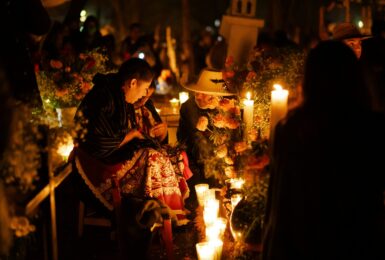
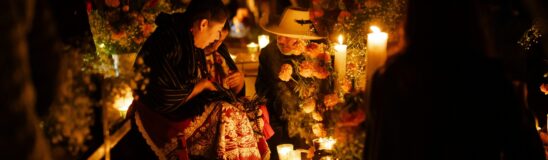
Look to Halloween customs around the world, specifically the Day of the Dead in Mexico. Fundamentally, it’s a holiday that revolves around honouring loved ones that have passed and connecting with ghosts. On paper it sounds creepy, but it’s actually incredibly wholesome.
So, are we actually obsessed with being scared?
I’m not sure if I can speak to it as an obsession, but there are arguments to be made that we’re digging deeper into exploring these unnerving things more and more.
The numbers certainly suggest we’re consuming a lot of it. A 2024 Edison Research study found that 84% of Americans aged 13 and over consume true crime in some form, whether that’s through television, YouTube, social media or podcasts. Forty-two per cent have listened to a true-crime podcast while 50% of true-crime podcast listeners say they enjoy the suspense and thrill.
And horror isn’t exactly struggling either. In 2025, horror films had the highest median return on investment of any major film genre, at 2.6, according to UCLA’s 2026 Hollywood Diversity Report.
And yep, the appetite for all things spooky is also showing up in travel.
Take Salem, Massachusetts. The city’s tourism industry is intrinsically linked to its witch trials and spooky history, and October is its biggest tourism period. In October 2019, 782,000 unique visitors came to downtown Salem. In October 2025, that number had risen to 1.1 million – a 41% increase.
That’s not proof that every visitor is booking a trip specifically to be scared, but it does show how deeply spooky history, folklore and tourism can become intertwined.
In the end, it’s possible that our obsession with fear isn’t really about fear itself. It’s about what it reveals to us, the discomfort it forces us into and the peripheral emotions that come out alongside it. Fear gives us adrenaline, it gives us catharsis, it can bring us closer to other people (sometimes literally) and we might even learn something new about ourselves.
And maybe that’s the real appeal in all things spooky: we want to get close enough to feel it – but not close enough to actually live it.